


India is abundantly blessed with a unique, rich and diverse range of wildlife and forest cover. However, rapid modernisation and urbanisation over the years have resulted in deforestation and habitat loss. Forests are also facing illegal hunting, poaching and climate change, while man-animal conflicts have become a recurring problem. Despite these hurdles, India continues to formulate wildlife conservation projects aimed at preserving wildlife alongside forest cover.
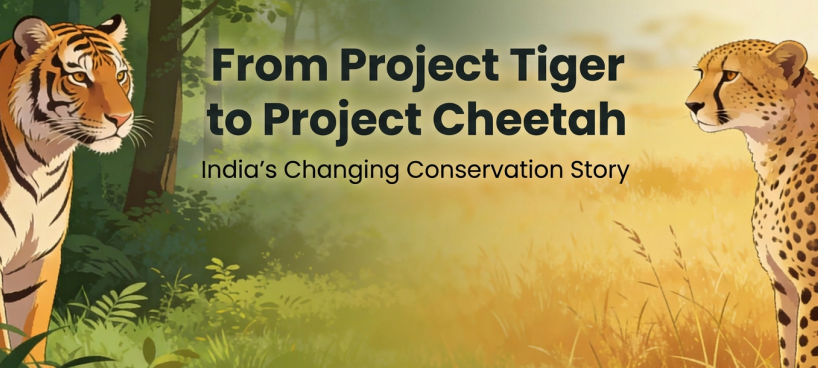
In 1973, India launched Project Tiger with a commitment to protect the endangered Bengal Tiger. Five decades on, India is attempting to reintroduce the Cheetah, which went extinct in 1952 due to excessive hunting during the colonial period. The project's aim to restore the Cheetah to the forest ecosystem demonstrates that the country's conservation vision has matured from emergency protection to ecological restoration.
Project Tiger: Protecting the National Animal
The Indian Government launched Project Tiger in April 1973 to address the dwindling numbers of tigers within Indian forests. Poaching and shrinking forests had directly caused a drastic decline in tiger numbers, such that by the early 1970s the population had fallen to just 1,800. The programme identified key tiger habitats and designated them as protected tiger reserves. The government then concentrated on reviving degraded forests, introduced anti-poaching legislation, scientific monitoring and involved local communities in protection endeavours.
The government's strategic planning and hard work paid off. The tiger population rose to an estimated 3,167–3,682 by 2022, successfully bringing our national animal back from the brink of extinction. India now houses approximately three quarters of the world's wild tigers across more than 50 reserves. The reserve have also begun to flourish, enriching biodiversity and proving that protecting a single species can in turn revive entire ecosystems. Project Tiger thus became the cornerstone of India's conservation achievements and helped unify forest and wildlife governance systems.
Lessons from Project Tiger
Project Tiger was India's resolute effort to save its national animal from extinction. The programme demonstrated that saving the tiger is not merely about protecting a patch of forest, but requires the coordinated restoration of forests, biodiversity and natural resources. The project also highlighted the importance of working in partnership with local communities, resolving human-animal conflict and ensuring that people living near reserve parks are included in conservation plans. The introduction of technology such as camera traps and radio collars, alongside long-term monitoring and adaptive management, has greatly benefited tiger conservation. The principal lesson, however, is the realisation that conserving an apex predator such as the tiger simultaneously aids the revival of the full ecosystem.
Project Cheetah: A Shift From Protection to Restoration
In 2022, the Indian Government announced its ambitious project to reintroduce the cheetah into Indian forests. Cheetahs had been declared extinct in 1952 owing to excessive poaching and habitat loss. With Project Cheetah, India is shifting its focus from protecting animals on the verge of extinction to reintroducing extinct animals back into their ecosystems. Cheetahs from Namibia and South Africa were relocated through intercontinental translocation to Kuno National Park in Madhya Pradesh.
Project Cheetah is a meticulously planned, science-backed programme that aims to revive open forest and grassland ecosystems within the Indian landscape and reshape biodiversity through the reintroduction of the Cheetah. The project involves extensive scientific research, constant monitoring and careful habitat preparation to ensure that the cheetah can adapt to its Indian surroundings. This shift in the scope of wildlife conservation clearly signals India's growing confidence in reimagining biodiversity through international collaboration and rigorous ecological planning.
What the Tiger–Cheetah Shift Means for Wildlife Conservation
Tiger conservation and cheetah conservation are grounded in entirely different philosophies and objectives. Project Tiger focused on improving the health of forest habitats and enhancing their natural resources. Project Cheetah, by contrast, takes a more holistic approach. It aims to protect neglected ecosystems such as grasslands and semi-arid areas, which in turn helps safeguard the many other species that form part of those ecosystems. In other words, as the focus of wildlife conservation has shifted from tiger to cheetah, the scope has broadened from a species-centric approach to an ecosystem-centric one. Through this shift, India is signalling that it is prepared to move from crisis-driven conservation to proactive, strategy-based ecological planning.
Challenges Ahead
No matter how sound an idea appears on paper, its execution invariably presents real-world challenges. The success of reintroducing African cheetahs will depend on the animals' adaptation to their new habitat, the availability of prey, immunity to disease and how well they fare in the Indian climate and landscape. Important issues such as human-wildlife conflict and the concerns of local communities near release sites must be carefully studied and addressed. The cheetah restoration project can also draw upon the valuable lessons of tiger conservation, including village relocation and conflict resolution. Nevertheless, long-term monitoring, scientific guidance and a willingness to adapt strategy remain crucial to its success.
The Road Ahead
India's wildlife conservation journey is built upon the success of Project Tiger. The lessons learnt from tiger conservation have enabled India to take the next step with Project Cheetah. However, in its pursuit of restoring lost ecological elements to the Indian landscape, the country must strike a careful balance between urbanisation and environmental responsibility. It must also remain mindful of adverse factors such as climate change, increasing human-wildlife conflicts, dwindling forest areas and a surging population. The future of Indian wildlife conservation depends upon protecting diverse habitat types ranging from dense forests and wetlands to grasslands and deserts. Conservation cannot succeed without community engagement, constant monitoring, continuous scientific research, evidence-based policy guidance and an unwavering commitment to prevail.