India’s growth from an agrarian economy to one of the fastest-growing markets in the world has always been a fascinating case study. To some extent, this transformation has been enabled by the strategic use of credit as a financial tool. The past two decades have clearly witnessed a shift in the credit landscape—from credit being a last resort to becoming a routine financial instrument. NBFCs have been a driving force in this transition, integrating technology, data-backed analysis and last-mile reach to make credit more accessible and inclusive.
Today, NBFCs have embedded themselves deeply into the Indian credit landscape. Their loan portfolios, characterised by smaller ticket sizes and shorter tenures, have reconfigured how India saves, spends and manages volatility. This has drawn in more first-time borrowers while sustaining growth in repeat borrowing.
The New Face of Consumer Borrowing
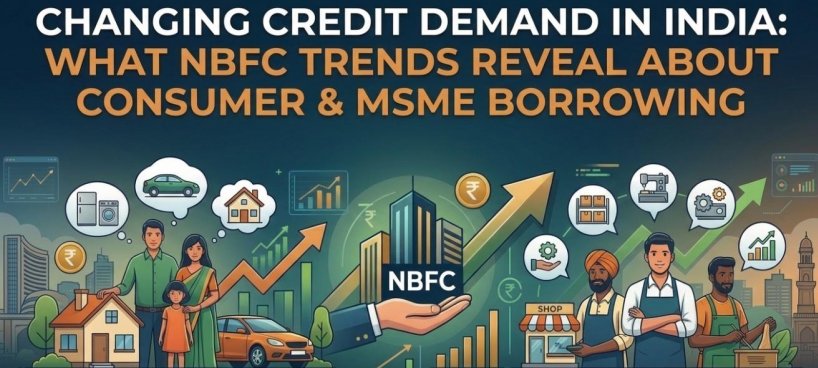
The Indian consumer credit segment has evolved significantly—from emergency-driven loans to convenience- and aspiration-driven finance. Individual and household consumers now rely on formal credit to manage short-term liquidity gaps, fund aspirational decisions and smooth cash flows. For many consumers, easy access to small-ticket, quick-disbursal loans functions as a safety net to fall back on.
Three signals strongly indicate the transformation of credit into a routine financial tool. The first is the rise of small-ticket, high-frequency loans that help household consumers manage monthly cash-flow volatility rather than one-off cash crunches. The second is the surge in the adoption of digital consumer loans, enabled by seamless and fully digital onboarding experiences. The third is the increased use of gold as a liquidity instrument, particularly in Tier-2 and Tier-3 cities, to support financial needs ranging from emergencies to aspirational purchases.
Behind these transformative trends lies a deeper shift in consumer behaviour. Income volatility is rising, gig and self-employment patterns are being widely adopted, and aspirational consumption is becoming mainstream. The economy has evolved into an environment where consumers increasingly borrow to participate in and finance urban lifestyles and aspirations. NBFCs have become the agents bridging this evolving consumer behaviour with the formal financial system.
MSME Credit: From Survival to Structured Growth
A similar shift is visible in the MSME credit sector. Earlier, businesses typically approached credit to address sudden liquidity needs or cash shortages. However, nowadays MSMEs are increasingly using credit as a financial instrument to scale their businesses and expand operations.
NBFCs have helped businesses move beyond traditional credit models and adopt technology-backed organised financial services. Lenders now use GST returns, e-invoices, bank statements and digital payment trails to analyse the financial health of businesses. Using this data, lenders can offer entrepreneurs more tailored loan products that align with business cash flows.
In addition, products such as invoice financing and receivables-backed loans enable MSMEs to unlock cash tied up in unpaid dues, providing liquidity without waiting for long settlement cycles. For an enterprise that is scaling up, such services can make a significant difference and help avoid missing growth opportunities.
In essence, MSME borrowing patterns reveal a shift away from survival-oriented loans towards structured and continuous liquidity support. NBFCs are contributing to the entrepreneurial journey of MSMEs by designing loan products that reflect real-time financial data and actual cash flows.
What NBFC Portfolios Are Signalling
If we closely examine the balance sheets and portfolios of NBFCs, three distinct signals emerge.
First, short-tenure, smaller-ticket loans are becoming the dominant product. These allow lenders to track repayment behaviour more effectively, identify potential risks and diversify exposure across a broader borrower base. For borrowers, such products offer flexibility, allowing loans to be drawn, repaid and renewed based on actual income patterns.
Second, there has been a substantial rise in first-time as well as repeat borrowers, indicating that formal credit is increasingly embedded in everyday financial behaviour. While new borrowers signal successful financial inclusion, repeat borrowers demonstrate that NBFCs have become an integral part of the financial habits of consumers and MSMEs. Recurring borrowing also reflects trust, appropriate product fit and operational ease.
The third signal is the strategic alignment between banks and NBFCs through co-lending models. These blended arrangements combine banks’ low-cost funds with NBFCs’ last-mile insights, reshaping how credit is structured and delivered.
Structural Forces Behind the Shift
These portfolio patterns are not accidental; they are the result of a series of structural forces shaping how individuals and businesses earn, spend, save and manage liquidity.
The rise of UPI payments, Aadhaar verification, e-KYC, e-invoicing and GST data trails has enabled financial institutions to assess the financial health of borrowers more accurately. This has reduced lenders’ dependence on paperwork and collateral, significantly shortening onboarding and documentation processes. Financial institutions can now verify identities instantly, assess risk through digital footprints and bring more borrowers into the structured financial system.
At the same time, enhanced credit bureau tracking allows lenders to evaluate borrowers’ repayment behaviour more effectively. This enables NBFCs to offer tailor-made loan products, sanction repeat loans based on repayment performance and identify borrowers with strong credit histories.
Finally, the rise of gig work, self-employment and freelancing has resulted in more volatile income patterns, prompting households to prefer flexible, short-duration credit. NBFCs have recognised this trend and are financing the liquidity demand arising from these social and macro-economic changes through tailored financial products.
The Road Ahead: From Lenders to Ecosystem Builders
Looking ahead, India’s credit landscape will increasingly be shaped by data-driven underwriting, artificial intelligence and embedded finance. Evaluating borrowers based on spending patterns and actual income behaviour will allow lenders to build credit portfolios centred on behaviour-led risk management.
Credit, as a routine financial tool, will become so deeply embedded in daily economic life that merchant POS systems, e-commerce checkouts and other digital platforms will enable borrowers to access contextual credit whenever required. The challenge for NBFCs will be to design credit products that are fast, sustainable and aligned with the actual cash flows of borrowers.
In this evolving environment, NBFCs will be judged by how effectively they can assess borrowers’ financial health and build real-time credit ecosystems around it. Their broader responsibility will be to ensure that the growth of India’s credit landscape remains organic, inclusive, sustainable and resilient.


