


There is a particular kind of sadness and grief that comes from watching something irreplaceable disappear slowly. That is what I feel when I think about what is happening to Kerala's waterbodies — the rivers, backwaters, lakes and wetlands that have sustained this land and its people for centuries.
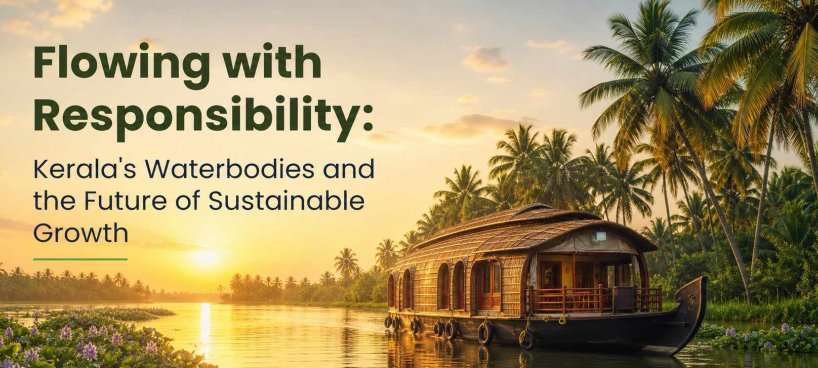
Kerala, whose very name derives from kera (coconut) and alam (land), is a state defined by water as much as by its legendary greenery. Its 44 rivers crisscross the terrain, feeding into serene lagoons, backwaters and wetlands of extraordinary ecological richness. Vembanad Lake is not merely a geographic landmark; it is a living ecosystem, a cultural inheritance and an economic lifeline. So too is Kuttanad, that remarkable stretch where farmers have cultivated rice below sea level for over 150 years, a practice so unique that global organisations have recognised it as an important agricultural heritage system.
These are not assets we can afford to squander.
The Wealth We Are Losing
Kerala's waterbodies have always been the silent engine of its prosperity. Since the spice trade era, rivers and canals carried goods — spices, rice, coconut products, timber and coir — from inland areas to coastal ports. Today, fisherfolk depend on these waters for their livelihoods. Houseboat tourism built around the traditional kettuvallam generates crores in annual revenue. Inland waterways connect islands and interiors to the mainland. These are not romantic memories of a bygone era. They are active, functioning economic systems — and they are under threat.
A Purple Menace
One of the gravest threats is also one of the most deceptively beautiful. Water hyacinth, introduced to India during the British colonial period as an ornamental plant, has since become an ecological catastrophe. Beneath those vast carpets of purple flowers lies destruction. The plant blocks sunlight, strips oxygen and nutrients from the water, and devastates fish populations and native aquatic life. Fishing nets get entangled and torn. Irrigation canals are jammed. Houseboat operators find their routes cluttered, their motors damaged.
But the most alarming consequence is one that is largely invisible. When water hyacinth decomposes, it releases methane — a greenhouse gas approximately 28 times more potent than carbon dioxide over a 100-year period. Scientific research has further established that when the plant is rooted in shallow sediment, it actively transports methane from the underwater sediments through its stems into the atmosphere. Something that appears as a harmless ornamental plant is, in reality, an invisible contributor to climate change — choking our waterbodies and warming our planet simultaneously.
The Larger Crisis
Water hyacinth does not act alone. Untreated wastewater, agricultural drainage laden with fertiliser runoff and unregulated land development trigger eutrophication — a process that enriches water with excessive nutrients, further fuelling weed growth. Meanwhile, our wetlands and mangrove forests, which once acted as nature's sponges against floodwaters, are being illegally encroached upon at an alarming rate. The consequence is a state that swings between devastating floods and severe summer droughts — a cycle that is becoming grimly familiar.
The Path Forward
I believe Kerala can reverse this decline, but it demands decisive, coordinated action. The water hyacinth crisis, for instance, is not without opportunity. The plant can be converted into biogas, recycled paper and handicrafts, transforming an ecological burden into a livelihood resource for local communities.
Comprehensive eco-restoration plans — covering flood-affected areas, wetland revival, drainage improvement and rainwater harvesting — are not aspirational ideas. They are practical necessities.
Most importantly, this cannot be the concern of government alone. Businesses, local communities, civil society organisations and individual citizens must all be active participants. Kerala's waterbodies have sustained generations. They have shaped our economy, our culture and our identity. The responsibility of protecting them belongs to all of us equally.
I began by speaking of sadness and grief. But grief, when it is shared and channelled, can become resolve. That resolve is what Kerala's waterbodies need from us — urgently, and without further delay.